Pinpad - Installation Manual
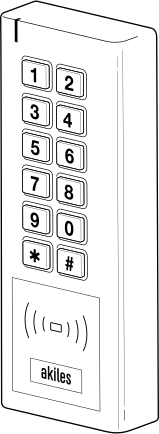
The Akiles Pinpad electronic keypad, fully integrated into the Akiles access management ecosystem, is a device that can be powered either by a power supply or alternatively operated by batteries, with very simple installation, allowing you to manage your access intelligently, connecting your doors to the internet, using users’ smartphones (Akiles app) as a virtual key.
It is also possible to open the door with contactless RFID/NFC technology (by presenting a valid card) and by entering a PIN code (mechanical keypad).
It can be configured as a remote keypad, delegating door opening to another Akiles device (examples 1 and 2) or alternatively as a local keypad, being capable of directly managing an electrified access, through connection to an electric door opener (example 3).
The Akiles Pinpad device is vandal-resistant and suitable for outdoor installation. It is the perfect solution for any type of door, room, office, common areas, etc. Installation examples (Internet connection via fiber/ADSL router or mobile network):
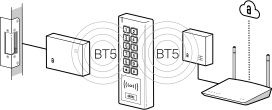
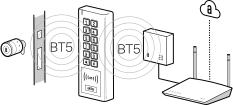
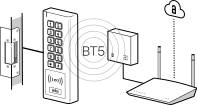
Description
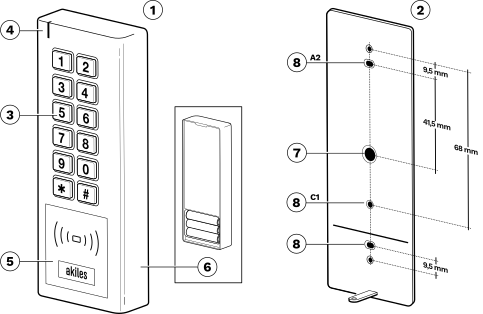
- 1. Front assembly
- 2. Wall bracket
- 3. Backlit mechanical keypad
- 4. Status LED
- 5. RFID/NFC antenna
- 6. Battery holder (on the back)
- 7. Cable passage hole
- 8. Wall anchoring holes. A2, C1 (recommended holes)
Box contents
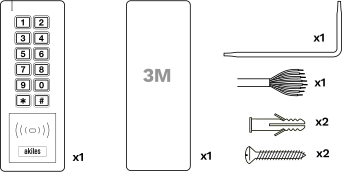
- Akiles Pinpad x1
- 8-wire cable x1
- Front assembly fixing key x1
- 3M VHB™ double-sided adhesive x1
- Wall plugs x2
- Self-tapping screws x2
Technical specifications
| Feature | Description |
|---|---|
| Access | via App (smartphone), NFC card, PIN code between 4-20 digits (keypad) |
| Modes (Internet) | online (with Internet connection) and offline (without Internet connection) |
| Modes (local/remote) | local keypad (manages access directly) and remote keypad (delegates opening to another Akiles device in the installation) |
| High-security NFC | MIFARE® DESFire® EV2 / MIFARE® DESFire® Light |
| Signaling | 1 RGB LED (status), 12 white LEDs (keypad backlighting) and buzzer |
| Sensors | Capacitive proximity sensor, Anti-tamper, 1 button input (exit button) and 1 door sensor input |
| Power supply (batteries) | 3 x 1.5V alkaline batteries LR03 AAA (3 V <Vbat <4.8 V) |
| Battery life | ≥2 years (10 operations/day. 3 x AAA alkaline 1200 mAh). |
| Power supply (source) | 12 V ac/dc and 24 Vdc (±10%). Consumption <1W. If both are present (power supply and batteries), the device will be powered through the source. |
| Switching capacity (device powered by source only) | 1 miniature relay (potential-free). Maximum 30V @ 2A. Connection to door opener |
| Access restrictions | by user, by access/device in the installation, temporary restriction (schedules), geolocation. |
| Connectivity | BT (5.0, 4.x). Internet through Akiles GW/CE/CM |
| Temperature range | -10..+55°C |
| Relative humidity range | 10..90% (without condensation) |
| IP rating | IP65 |
Status indicator light signals (RGB LED)
LED operation: With batteries you must press a key to see the status, and with power supply the status LED is always active.
| Color | Blinking | Meaning |
|---|---|---|
| Blue | No | Initialized, everything OK |
| Fast | Updating configuration | |
| Slow | Updating firmware | |
| Green | Action completed (open) | |
| Red | No | Restart |
| Fast | Restoring factory settings | |
| Yellow | 1 | Connection not received from gateway |
| 2 | No connection with Controllers/Cylinders/Roomlocks |
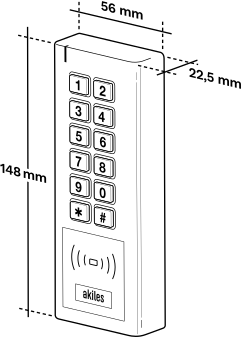
Dimensions
Installation diagram
Pinpad (local keypad) with power supply:
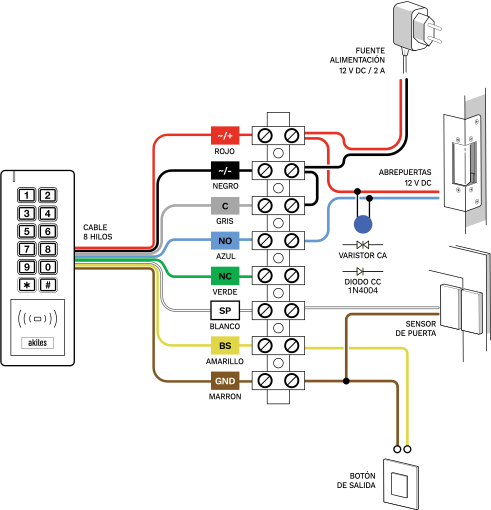
Note #1: The selection of the keypad operating mode (Pinpad / Pinpad remote) can be done from the administration panel (Devices).
Note #2: Size the power supply amperage so that it supports the consumption demanded by the door opener to be installed.
Considerations before installation
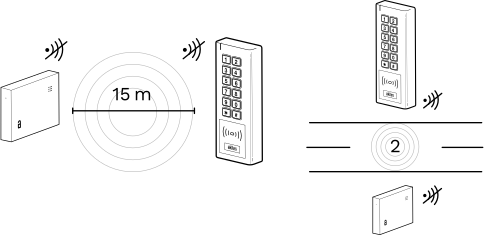
If 2 devices are to be paired to communicate via Bluetooth, the separation between them should not exceed 15 m on the same floor, nor be separated by more than 2 floors, in order to have good RF coverage.
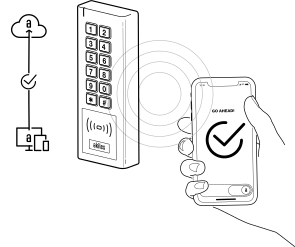
Once the installation has been registered on the Akiles servers (via the administration panel) and if the configuration is correct, the system should work perfectly.
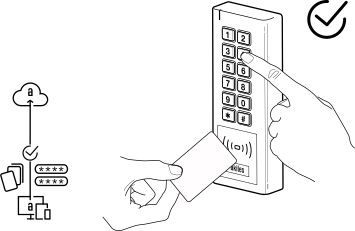
Authorized PIN codes and NFC cards must be registered via the administration panel. It is recommended to use Akiles NFC cards and key fobs.
On a newly installed device, wait one minute after startup before testing the door opening.
Once access has been validated (app, NFC card or PIN code) the system will switch the relay for the programmed time (pinpad mode, if the device is powered by a power supply), or will transfer the opening command to another device in the installation if configured that way (remote pinpad mode, regardless of whether it is powered by batteries or power supply). The operating mode configuration can be done in the administration panel.
It is possible to restore factory settings in case a malfunction of the device is detected. To do this, use the reset button (press for more than 10 seconds) located on the back of the keypad (marked as SW1).
Device installation
Method 1. Installation using 3M double-sided adhesive (metal doors, glass or smooth wall surface).
1. Remove the rear bracket of the keypad, using the supplied key.
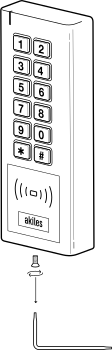
2. Attach the bracket to the 3M VHB™ double-sided adhesive. Secure it to the wall in the desired position.
IMPORTANT: 3M VHB™ tape is a double-sided adhesive tape made of acrylic foam and pressure-sensitive adhesive, specially designed for industrial use. Optimal bonding results are obtained after 24 hours. The optimal temperature range for using this adhesive is between 20°C and 40°C. Do not use in environments with temperatures below 10°C.
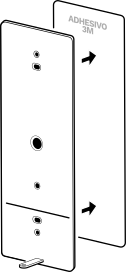
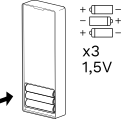
3. Insert the batteries (3 x AAA) into the battery holder respecting the marked polarity, if this operating mode is desired (remote keypad operated by batteries). Secure the front assembly of the keypad to the wall bracket, using the supplied key.
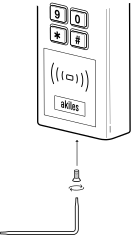
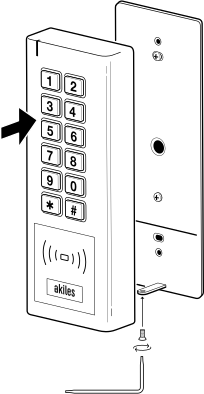
4. Secure the front assembly of the keypad to the wall bracket, using the supplied screw (to be placed at the bottom). Use the provided key.
Method 2. Surface installation using fixing screws (wooden wall/door).
1. Mark the fixing points using the wall bracket as a template. It is recommended to use the points marked as C1 and A2 in the figure. Make the necessary holes with a drill and insert the corresponding plugs.
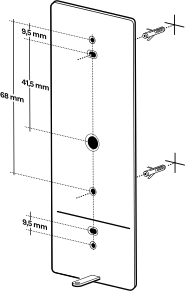
2. Secure the wall bracket using the supplied fixing screws. Make the necessary connections using the supplied 8-wire cable (see installation diagram pg 6).
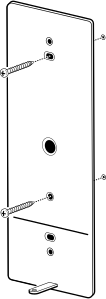
3. Secure the front assembly of the keypad to the wall bracket, using the supplied screw (to be placed at the bottom). Use the provided key.
Device operation
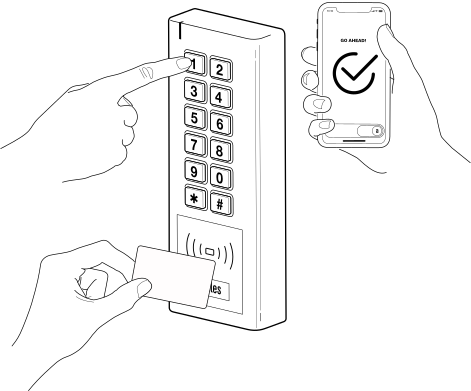
Numeric code: Configure as many PINs per user as you want, remotely. They will be useful in case you don’t have access to any mobile phone or card.
App: The app allows you to open remotely via a smartphone with Internet connection, or locally via BT4 / BT5 without Internet connection.
NFC card: Akiles customizable cards only contain the user identification (unique code), never the access permissions, which reside in the electronic lock. This greatly facilitates system administration.
Battery replacement
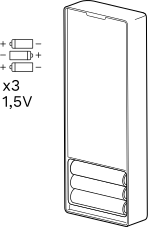
It is highly recommended to change the batteries when you receive the low battery notification. To change the batteries, you need to remove the front assembly of the keypad, using the provided key, loosening the fixing screw located at the bottom of the metal casing.
Remove the 3 used batteries from the battery holder and insert the new ones (3 x AAA) respecting the indicated polarity. If inserted correctly, the battery level (%) shown in the administration panel should be 100%.
Regulations and certifications
Information on the product’s wireless characteristics
BT5/BT4 frequencies: 2400–2483.5 MHz (max 8 dBm) NFC/RFID frequencies: 13.553-13.567 MHz (max 60 dBµA/m at 10 m)
Radio frequency exposure information (Maximum permitted exposure)
This device complies with EU requirements on limiting public exposure to electromagnetic fields in order to protect health. To comply with radio frequency exposure requirements, the equipment must be used at a minimum distance of 20 cm from the user.
This product complies with the provisions of the European Radio Equipment Directive (2014/53/EU).


This product complies with the essential requirements of Directive 2011/65/EU (RoHS 2), 2012/19/EU (WEEE) and EU regulation No. 1907/2006 (REACH).
The WEEE symbol (Waste Electrical and Electronic Equipment) indicates that this device and batteries (if included) should not be disposed of with other household waste.
When the product reaches the end of its useful life, take it to a waste collection point in your area for safe disposal or recycling.